

Shakespeare for sisters
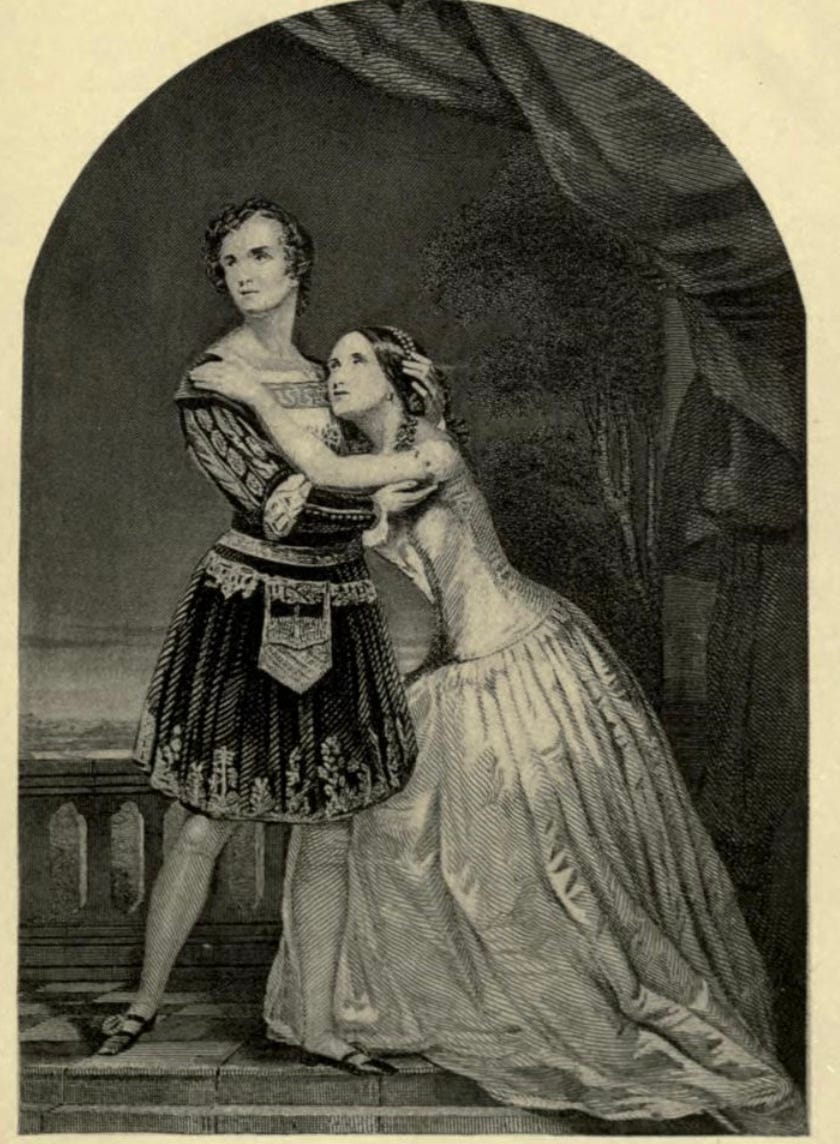
The Cushman sisters as Romeo and Juliet

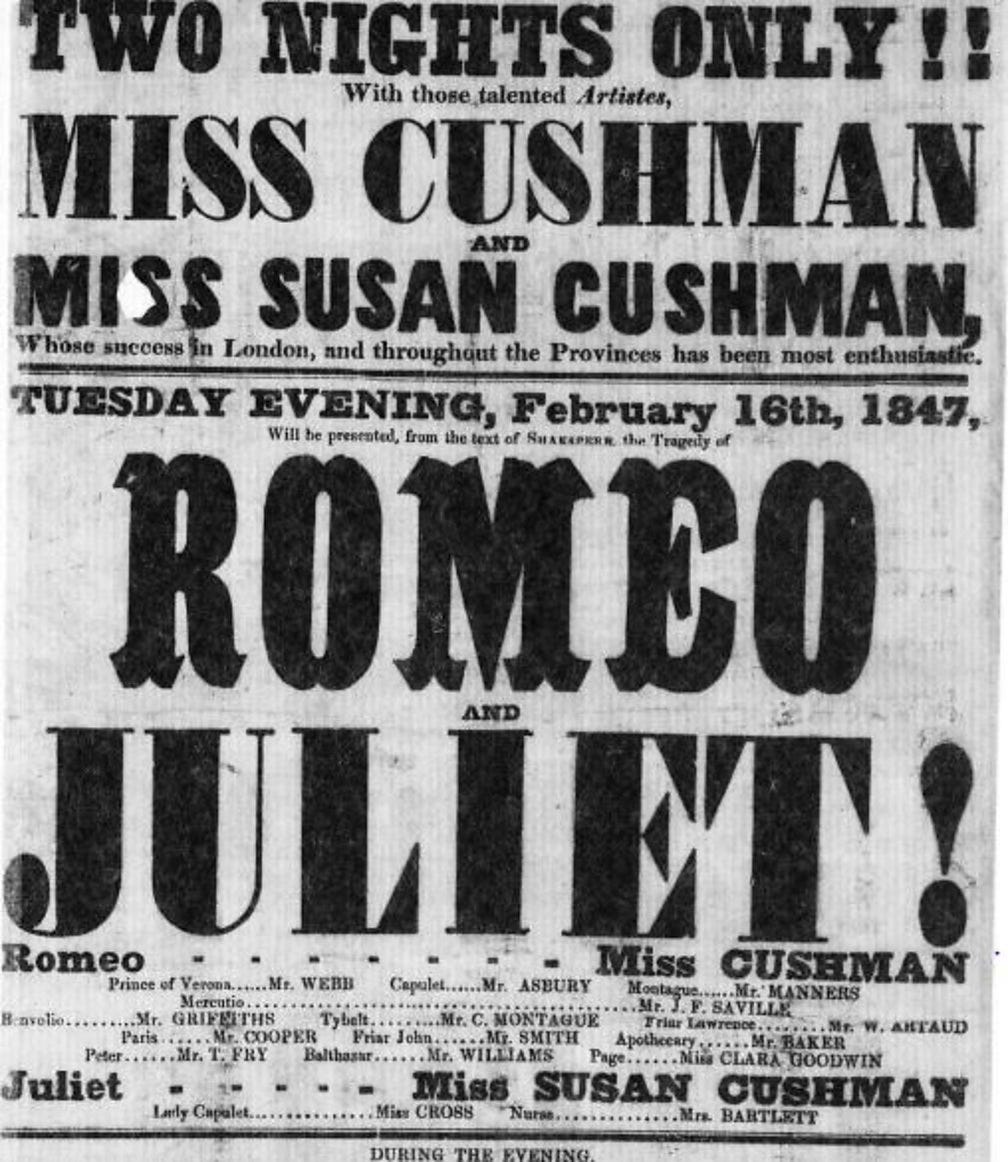
Women’s history can be so unexpected. Take the Cushmans, Charlotte and Susan, a pair of American sisters, playing Romeo and Juliet on the London stage in 1845. Really? How did that come about? And how were they received?
When I came across this story1 I immediately wanted to know more, and it didn’t take me long to discover Charlotte Cushman was one of the most distinguished (if not the most distinguished) American actresses of the nineteenth century. In a happy surprise, I also found I already had a book about her on my shelves: Lady Romeo: The Radical and Revolutionary Life of Charlotte Cushman, America’s First Celebrity by Tana Wojczuk (Avid Press, 2020). Known for her ability to inhabit any character, male or female, there were lots of fun things to learn about Charlotte: from losing her father aged twelve, in 1828, and deciding a singing career would be her best plan for supporting her mother and three younger siblings; to living in Rome with her lover Emma Stebbins, a sculptress, best remembered for this fountain in Central Park:

But what really stood out for me was Charlotte’s relationship with Susan. A true example of the power of sisterhood, Charlotte Cushman was a woman who made the most of her talents, took risks, and faced down opposition, particularly when it came to helping out her sister. In a time when women had minimal rights and autonomy, Charlotte was a powerhouse of independence and perseverance, and her sister reaped the benefits.
Susan was six and Charlotte was twelve when their father died. Of the two girls, it was Charlotte who understood the dire situation the family faced. According to an article in Appletons’ Journal in 1874:
Charlotte… became her mother’s chief helpmate and confidante in the struggle to live. Thus early was she matured, by becoming the sharer in heavy burdens, and learned the lessons of long-suffering and endurance. “Many a night,” she said, “I have lain awake, watching my mother walking the room, nigh distracted, she not knowing which way to turn or what to do – I fearing that she would rush from the house, and drown herself in the sea.”2
Charlotte embarked on voice training while her mother kept the family afloat running a boarding house. When her voice suddenly failed her, acting was the solution Charlotte found to their predicament. Her debut acting role was as Lady Macbeth, quite staggering when you think about it. It was 1836 and she was twenty years old. Even to land the part, Charlotte must have been an exceptional person, but her path to fame and celebrity wasn’t an easy one. Despite early success and glowing reviews it proved hard to get good acting roles in New York City. With hard work and determination she was proving herself at the Bowery theatre, when it was destroyed in a fire, and with it her precious store of costumes. It must have seemed to Charlotte that she’d never succeed in her goal of supporting her mother and siblings.
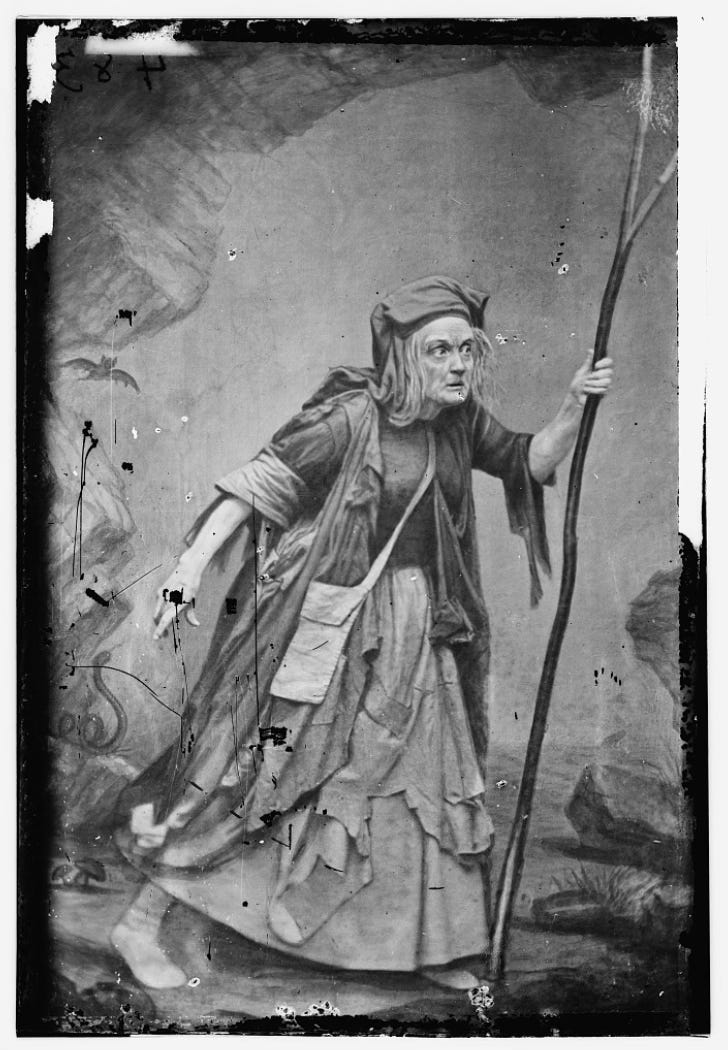
The family was forced to separate. Susan went to live with a family friend in Boston and their brother Charlie found a job as a sales clerk and remained in New York, while Charlotte, her mother, and her adored younger brother Augustus went to try their luck in Albany in upstate New York. There, further disaster struck. Augustus died after a fall from a horse. Charlotte returned to New York City and threw herself into acting at the Park Theatre, taking any and all jobs, but quickly gaining plaudits from critics including Walt Whitman who saw her perform as Meg Merrilies in Guy Mannering, where she transformed herself into an old gypsy woman.
Susan, meanwhile, had run into trouble of her own. The most detailed version of her story that I’ve uncovered so far, comes from two articles in a periodical called The Musical World, published in October 1846, and written by Charlotte’s friend Mary Howitt, an interesting woman in her own right.3 According to Howitt, when the family was struggling…
… a gentleman of Boston, in middle life, and a friend of the family, came forward and offered to take her sister Susan, then very young, entirely under his own care, complete her education, and, if the consent of her mother could be obtained, adopt her as his daughter. Susan was delicate in health, lovely in person, and timid in character; this offer, therefore, of a permanent and comfortable home was not to be rejected.4
But,
When Susan, however, was just turned fourteen he was taken dangerously ill of brain fever, and lay at the point of death.5
At this point the story goes quite off the rails. The Boston gentleman, a man called Merriman, suddenly proposed that he and Susan marry, ensuring that she would be financially secure and independent in the event of his expected death. Family members (I’m not sure who!) seemed to think this was a good idea, and despite Susan and her mother’s misgivings, the marriage took place. Merriman proceeded to recover and Susan soon was pregnant.
It gets worse. One morning, Merriman told Susan he was off to New York on business and no sooner had he disappeared than a host of creditors descended on her. He was bankrupt, and deserted his young wife without a backward glance. Susan never saw her husband again.
Charlotte Cushman now had a new family member relying on her, a nephew, and a younger sister crushed by melancholy and disappointment. Something had to be done.
Charlotte’s answer was to bring Susan out of herself by getting her into acting. Charlotte would be her sister’s teacher, and take male parts to allow Susan to play a female lead at her side. In The Musical World, Howitt explains it like this:
Mrs Merriman, or Miss Susan Cushman as she was theatrically called, made her first appearance before the public in a manuscript play called The Genoese, written by a young American, in which, to encourage her sister, Miss Cushman took the part of the lover. And here let a few words be said on a subject which has excited some remarks, and, as we think needlessly, to Miss Cushman’s disadvantage – we mean on her taking male parts. We can assert it as a fact, and it is a fact full of generosity and beautiful affection, that it is solely on her sister’s account that she has done so. By taking herself the male character, for which she was in many cases admirably suited, she was enabled to obtain the first female character for her sister; there being, as is well known, no plays written in which two prominent female characters are found. Affection for one who, if not possessed of her strong, original masculine talent, had yet beauty, grace, tenderness, and many requisites for a successful actress, made her (Charlotte) willing to give her every support and advantage she could.6
Charlotte’s support for her sister didn’t stop there either. In a bold move for the times:
The two sisters made their appearance on the stage together. Charlotte urged the manager to increase their salaries, hers to twenty-five dollars a week, her sister’s to twelve. Mr. Simpson refused, and the Cushman sisters left him and went to the stock company of Burton’s Theatre, at Philadelphia. It was not long before she was called back to the Park on her own terms; it was found difficult to replace one who did so many things thoroughly well.7
There’s a further story also, about a critic/journalist trying to get the pick of parts at the Park theatre for his girlfriend - at Susan’s expense. The manager, in need of good reviews, was inclined to agree, but he hadn’t factored in Charlotte. Charlotte wouldn’t hear of it, and her audience pull was too big to be ignored. Star-power won out and Susan kept getting good roles.
And so to England. Aged twenty-seven, the redoubtable Charlotte left the U.S. intent on making her mark in London, the undisputed capital of the theatrical world. She traveled with one maid for company, and found work at the Princess Theatre for J.M. Maddox. Playing Lady Macbeth again, she was an instant success and declared the new Sarah Siddons. But the work was relentless and Charlotte was lonely. She wrote to her sister, and asked her to come to London.
Casting Susan as Juliet had been Charlotte’s idea, and Maddox agreed, despite his skepticism. Susan was pretty and feminine, with large greenish-brown eyes and dark brown hair she wore parted in the center like her sister. She was shorter and slimmer than Charlotte… The idea of two sisters playing Romeo and Juliet was a novel one. In a twist, Charlotte also demanded that they work with the full text of the play, rather than the bowdlerized version from David Garrick that had been in fashion for decades.8
It’s fascinating to read about the reception Charlotte Cushman got when she took on male roles. You might think it would be pretty contentious. (For anyone looking for a rabbit hole to go down, google female actresses playing male Shakespeare leads and you won’t be disappointed. I definitely want to watch Fiona Shaw’s Richard II). From the reading I’ve done, while opinion was divided, it seems overall Charlotte was accepted as Romeo because she never acted like a woman acting the part of a man. She acted as Romeo. According to Tana Wojczuk in Lady Romeo:
Eventually even Queen Victoria weighed in. The young queen declared that while Charlotte “entered well into the character” of Romeo, no one would have ever imagined her a woman, her figure and voice being so masculine.9
Coming to England to be with Charlotte brought Susan acting success and also a new life. On tour in Liverpool she met a scientist, James Sheridan Muspratt. Reader, she married him, stayed in Liverpool and had three more children.
For more on Charlotte Cushman, with more detail on her acting achievements and her love life, I’d recommend Lady Romeo. Her later life in Rome is also worth learning about, and as usual with these things, while reading about Charlotte and Susan I picked up a couple of other interesting and lesser known sister pairings for future investigation.
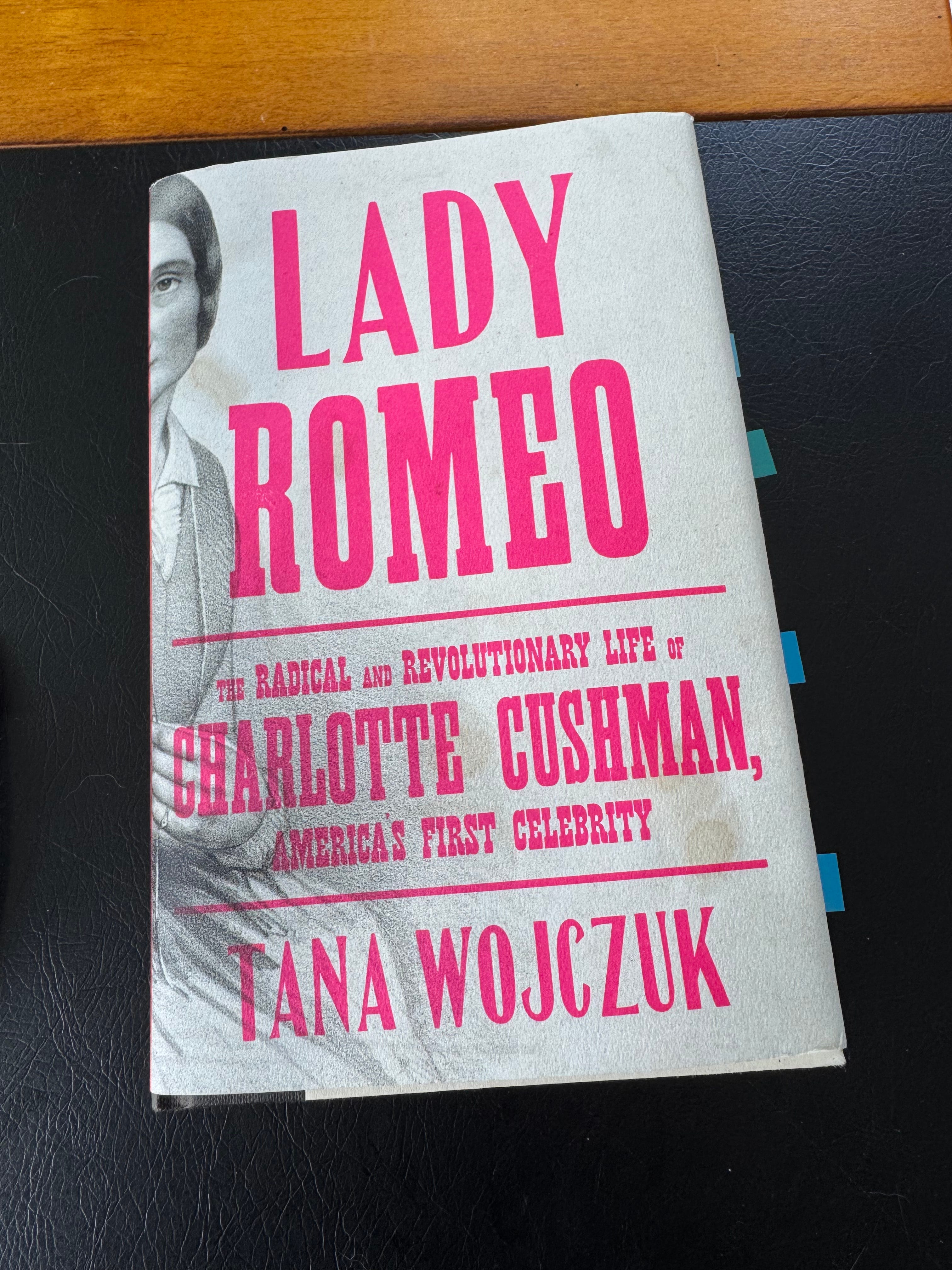
I found Charlotte first. She’s mentioned in the blurb for A Queer History of the United States by Michael Bronski. It’s on my tbr pile.
Appletons’ Journal, March 21, 1874, digitized by the University of Michigan
Mary Howitt was a writer and women’s right’s advocate. She’s also the author of the 1828 cautionary poem The Spider and the Fly
The Musical World, Vol 21 issues 40&41, Internet Archive
The Musical World, Vol 21 issues 40&41, Internet Archive
The Musical World, Vol 21 issues 40&41, Internet Archive
Appletons’ Journal, March 21, 1874, digitized by the University of Michigan
Lady Romeo: The Radical and Revolutionary Life of Charlotte Cushman, America’s First Celebrity, Tana Wojczuk, Avid Reader Press, 2020
Lady Romeo: The Radical and Revolutionary Life of Charlotte Cushman, America’s First Celebrity, Tana Wojczuk, Avid Reader Press, 2020
Yeah this was good.
Fascinating premise. Adding this to my TBR list!