

The Fox sisters
And a novel I won't write about them (probably)

There comes a time in the process of writing a novel when you start thinking about the next one… and I’m at that point, right about now.
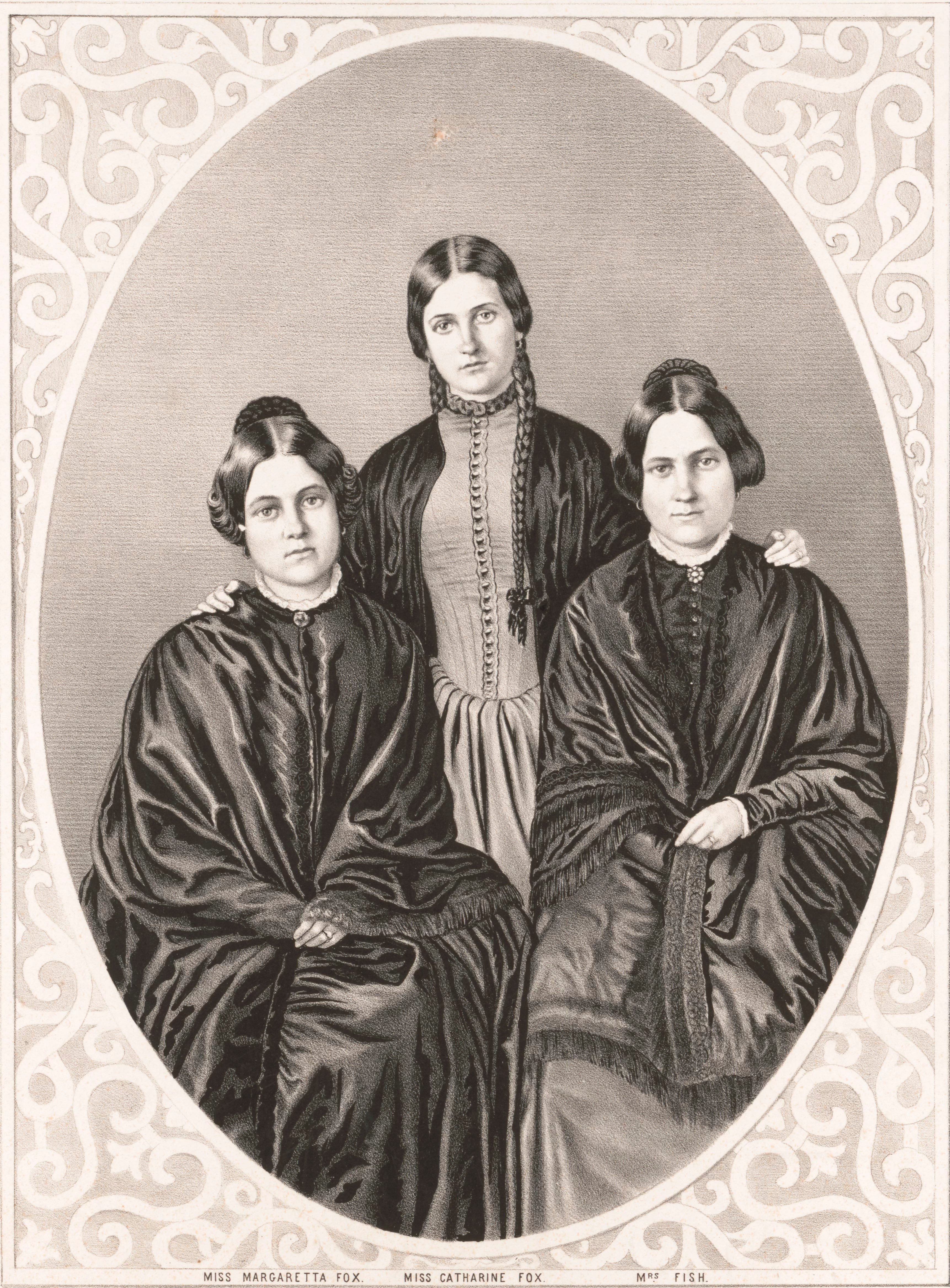
The Fox sisters have been on my ‘maybe’ list for the novel treatment for a while. Maggie and Kate, two young sisters, living in Hydesville NY, in 1847 came to sudden prominence when a series of strange noises - knocking and rapping - disturbed the family’s sleep. Neighbors were called in. Questions were posed and the knocking noises, mostly audible in the girls’ bedroom, seemed to be replying. Word spread quickly. Crowds gathered for nightly listening as the spirits indicated the house had been the scene of a murder. The first account of the affair appeared shortly after, in a forty page pamphlet:
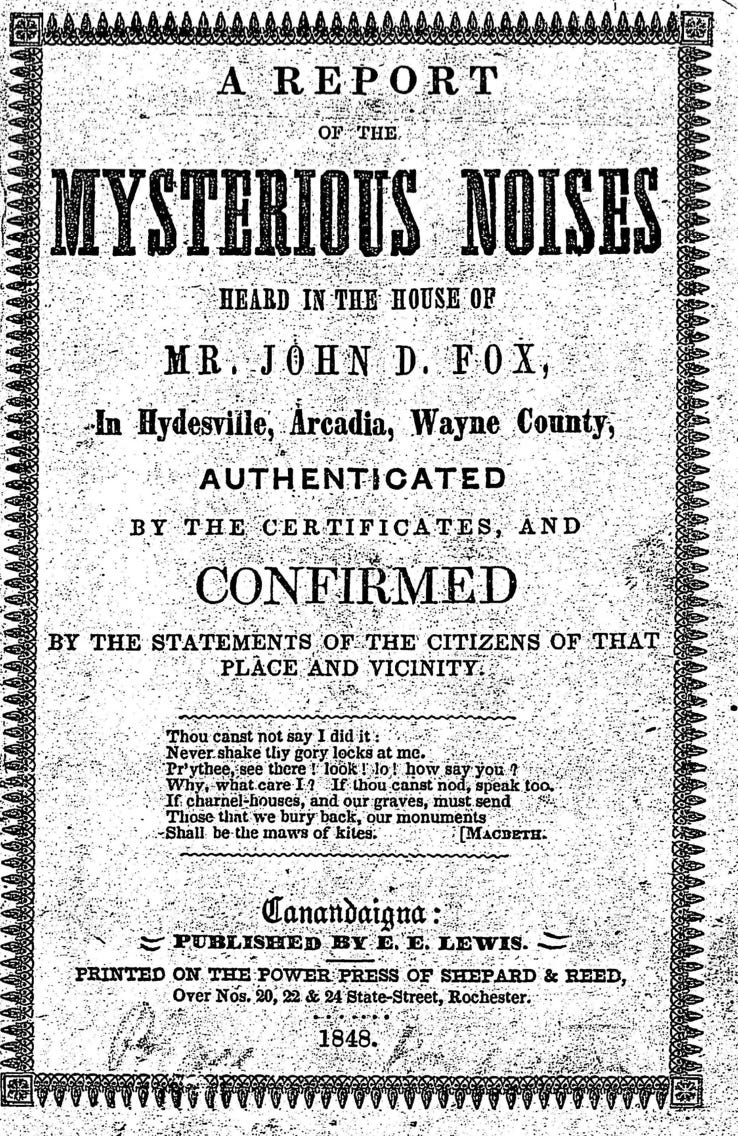
If I was going to write a novel about the sisters (I’m not, I’m not) then E.E. Lewis’ A Report of the Mysterious Noises would be a great starting point. It’s available on line here.
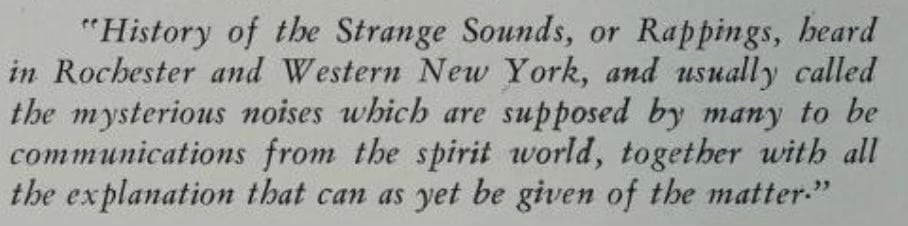
I’d also want to check out D.M. Dewey’s 1850 pamphlet, said to have sold an astonishing 30,000 copies1, snappily entitled:
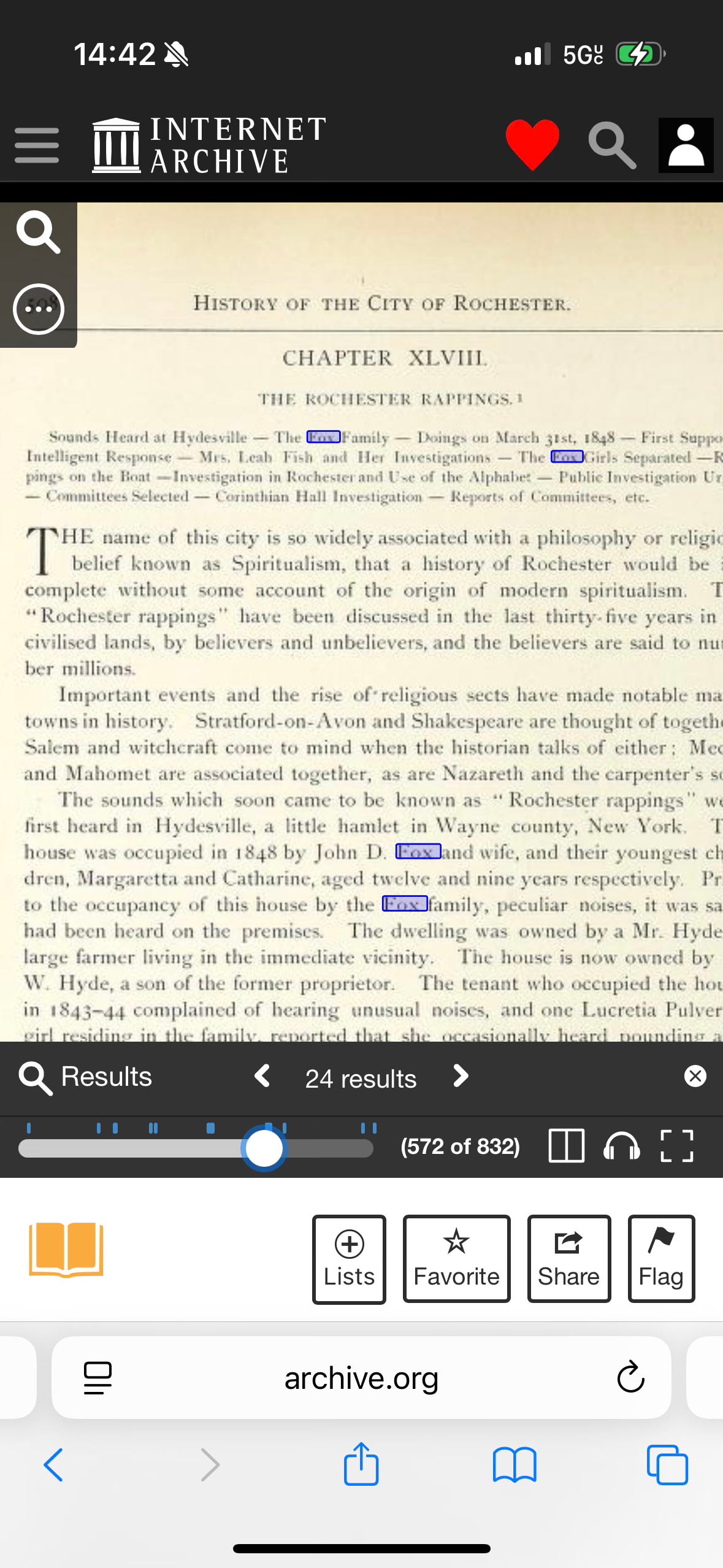
The family found themselves at the center of a drama. They left their haunted home and went to stay with Maggie and Kate’s much older sister, Leah Fish (great name!), in Rochester, but the strange rappings and spirit communications followed them there. Leah, it appears, saw an opportunity and seized it. They caused quite a stir in Rochester, especially when the spirits suggested to the girls that they should share their ability to communicate across the veil more widely - in the public interest, you understand. On November 14th 1849 therefore, a lecture/demonstration was given in Rochester’s Corinthian Hall. A committee was established to investigate further, and if I was writing a novel about the Fox sisters, I’d certainly want to read up on that in the Semi-centennial History of Rochester by William F. Peck that is happily available on the Internet Archive. I might even find it on my phone and take a quick screenshot, so I didn’t forget…
The Fox sisters’ rise to prominence was rapid. By 1950, they were in New York City giving audiences to men like Horace Greeley of the New York Tribune and the novelist James Fenimore Cooper. If I was writing a novel about them, I’d certainly need to know why and how they managed it. I’d probably gravitate toward some general books on the subject like this one, Out of the Shadows, Six Victorian Women in Search of a Public Voice by Emily Midorikawa. Even though it’s aimed at young adults, I’d certainly want to get hold of a copy of American Spirits by Barb Rosenstock, and I’d go to my own shelves to find Barbara Weisberg’s Talking to the Dead and the anonymously published volume, The Love-Life of Dr Kane, because it concerns the relationship between the Maggie Fox and the famed American Arctic explorer.
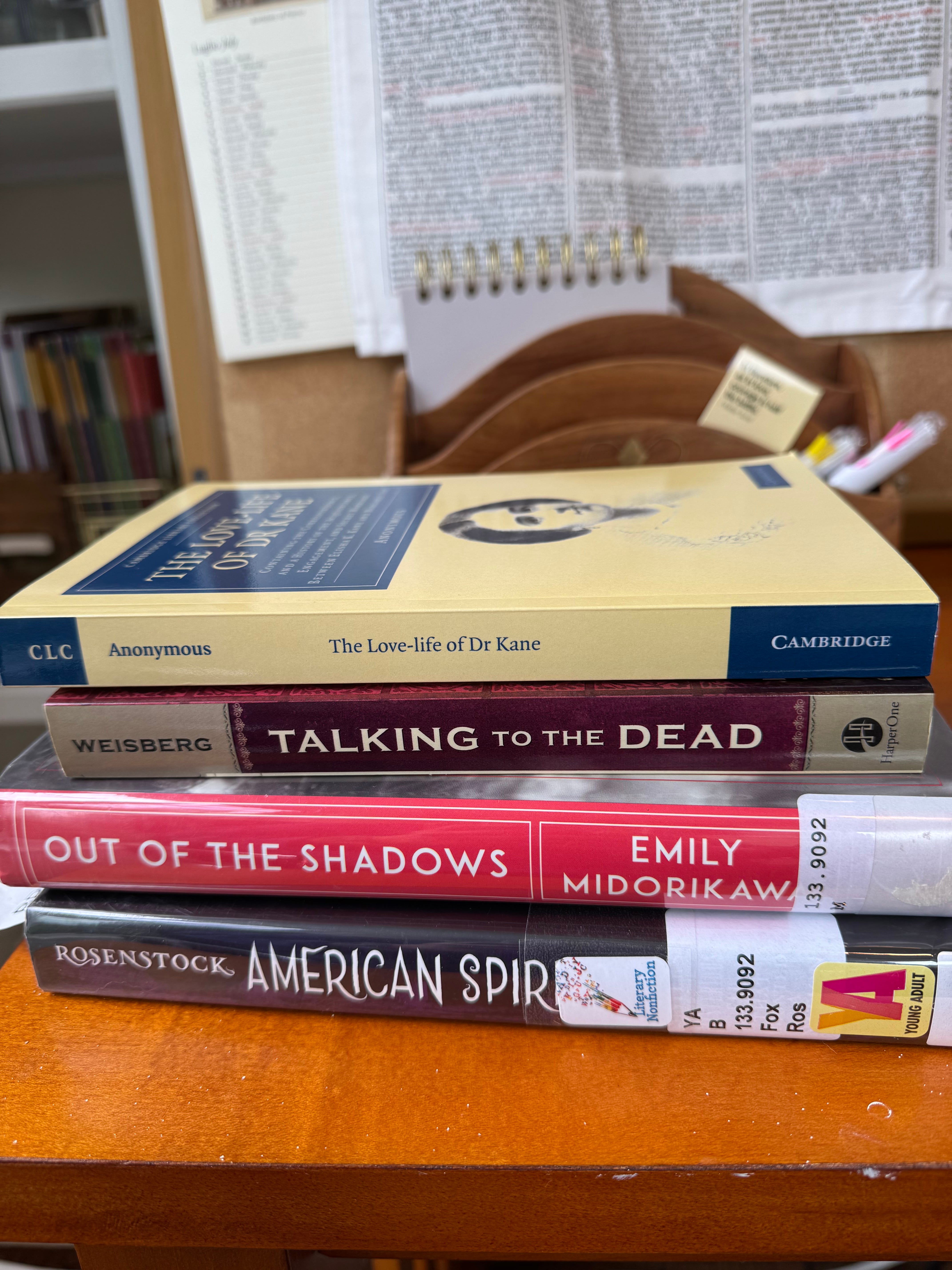
There’s no doubt a clandestine relationship and disputed marriage between one of the Fox sisters and Elisha Kane would be very interesting to a writer pondering a novel about these women. So would the fact that in October 1888, Kate and Maggie Fox very publicly declared their whole spiritualism career (one of ups and downs it has to be said) was a fraud.
In fact, a writer considering a novel about the Fox sisters with a free day on her hands in Boston, could do worse than spend a day in Boston’s wonderful Public Library taking a look at the Fox sister-related materials they happen to have there.
In the rare books section, a good starting point might be The Death Blow to Spiritualism by Reuben Briggs Davenport. Although available to read online, the chance to sit and read a first edition of the book - detailing Davenport’s 1888 interviews with the Fox sisters, their explanation of how the fraud was perpetrated, and the way the younger girls were manipulated by their older sister, Leah - would be right up any historical novelist’s alleyway.
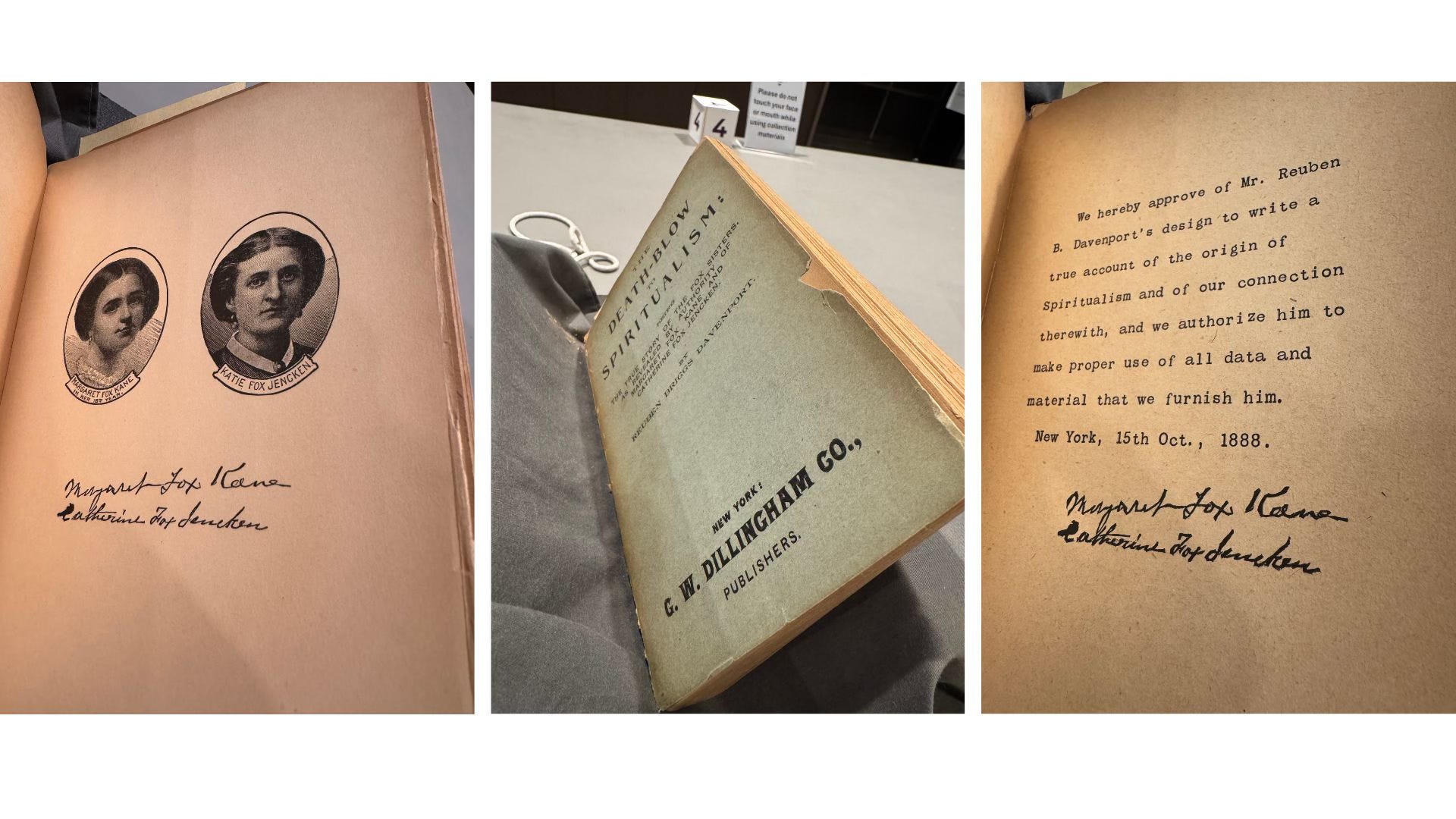
And what writer interested in sister stories wouldn’t find this quote from Maggie Fox had their imagination firing:
I do not exaggerate in any way when I say that I have feared that woman all my life. Remember, she is twenty-three years older than I am. Her influence over both myself and my sister Kate began when we were infants. Katie, even to this day, acknowledges some sinister influence about her sister Leah, even if she but chance to meet her in the street. It is a mixture of terrorism and cajolery.2
There are mentions of newspaper articles that would certainly be worth finding. In October 1888, Kate Fox feared her turn against spiritualism endangered the lives of her teenage sons. Perhaps older sister Leah was trying to prove Kate unfit to be a mother. And there’s certainly more to be discovered about Maggie Fox’s public lecture in New York City, when on October 22nd, 1888, she denounced spiritualism as a fraud, even demonstrating her ability to make the infamous rapping noises with her toes.
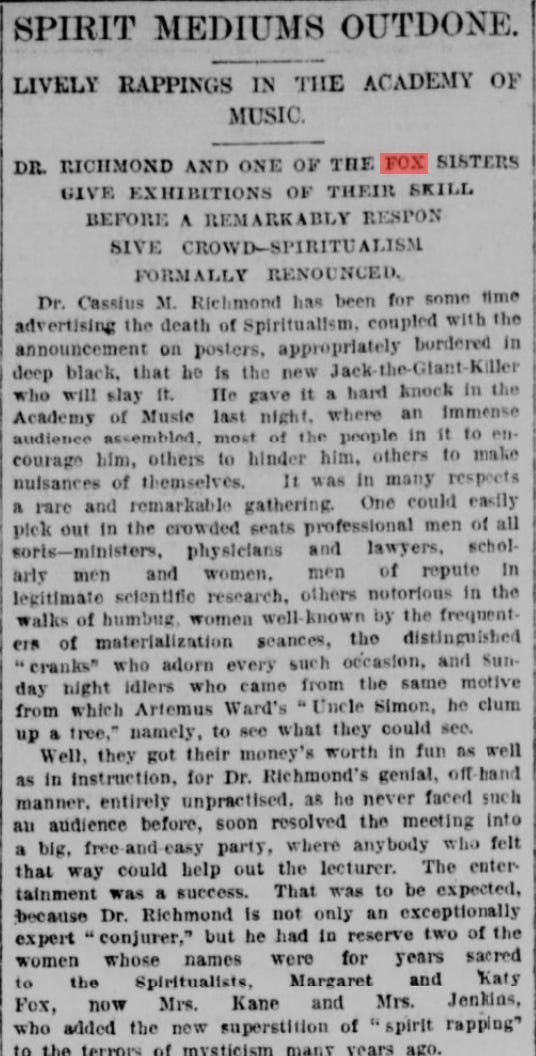
Maggie’s argument, as presented in The Death Blow to Spiritualism, is that she and Kate were young and taken advantage of by their elder sister:
Our whole family was at that time under bondage, as it were, to Ann Leah Brown3. She ruled over us as with a rod of iron. All through this dreadful life - from the time when I first realized its enormity - I protested against it. Dr. Kane, after our marriage, would never permit me to allude to my old career- he wanted me to forget it. He hated the publicity.
But when I was poor after his death, I was driven back into it. I have told my sister Leah over and again: ‘Now that you are rich why don’t you save your soul? But she would only fly into a passion. The truth is that nothing can excuse the work she has done. She entered upon it at the age of judgement and experience, fully aware of its falsity and evil effect. She knows that the world cannot forgive her, and I have no hope that she will ever confess her sin, or offer an atonement for it.4
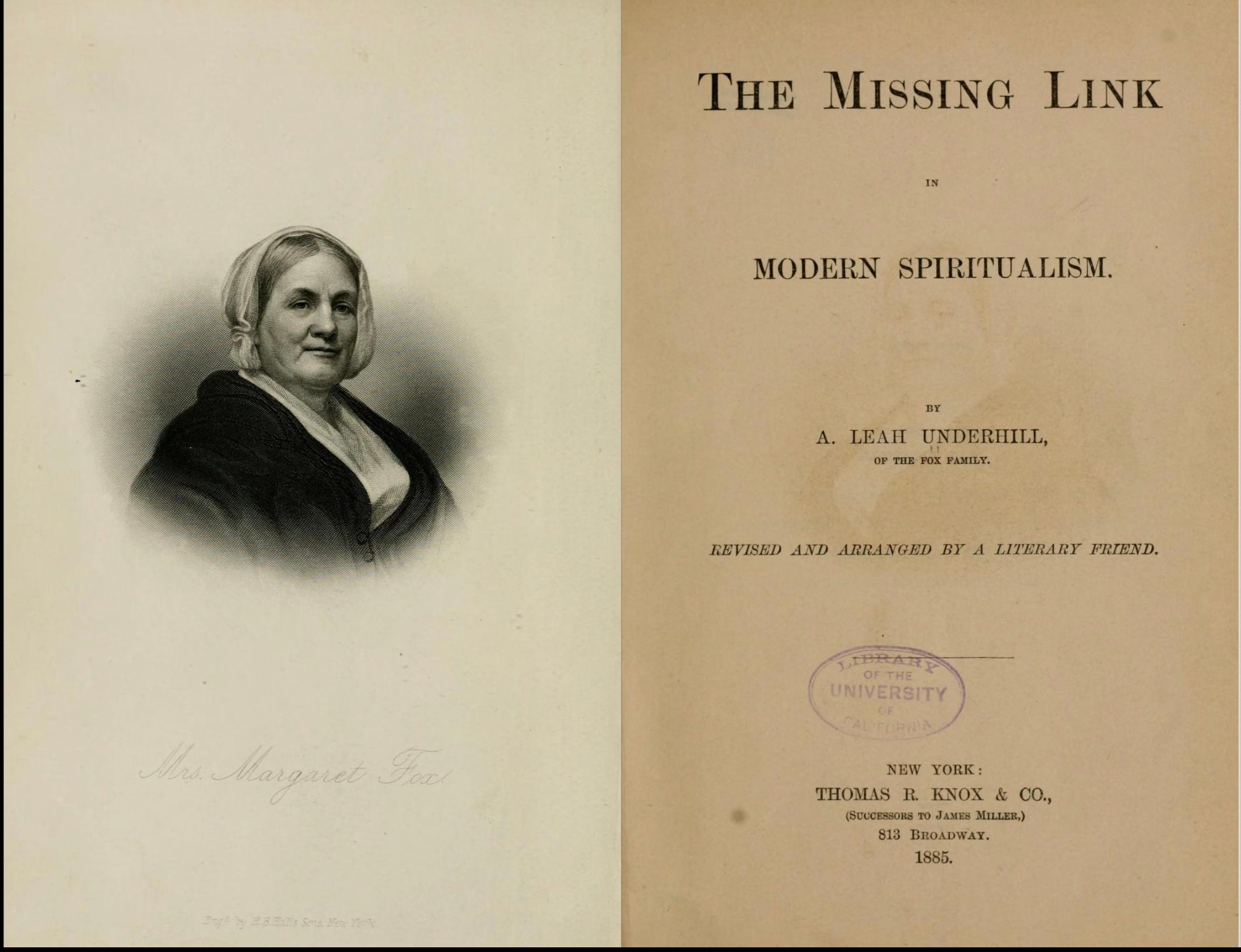
It goes without saying, then, that the imagined Fox sisters novelist would want to dig into Leah’s own narrative The Missing Link in Modern Spiritualism by A. Leah Fox Underhill (yes, no longer Mrs Fish) - also easy to find on the Internet Archive.
Boston Library’s copy of Leah’s book has gone missing, but if an interested writer still had time on her hands, she could do a lot worse than requesting a read of Rappings That Startled the World, a delightfully gossipy and well illustrated little book with lots of leads to explore.
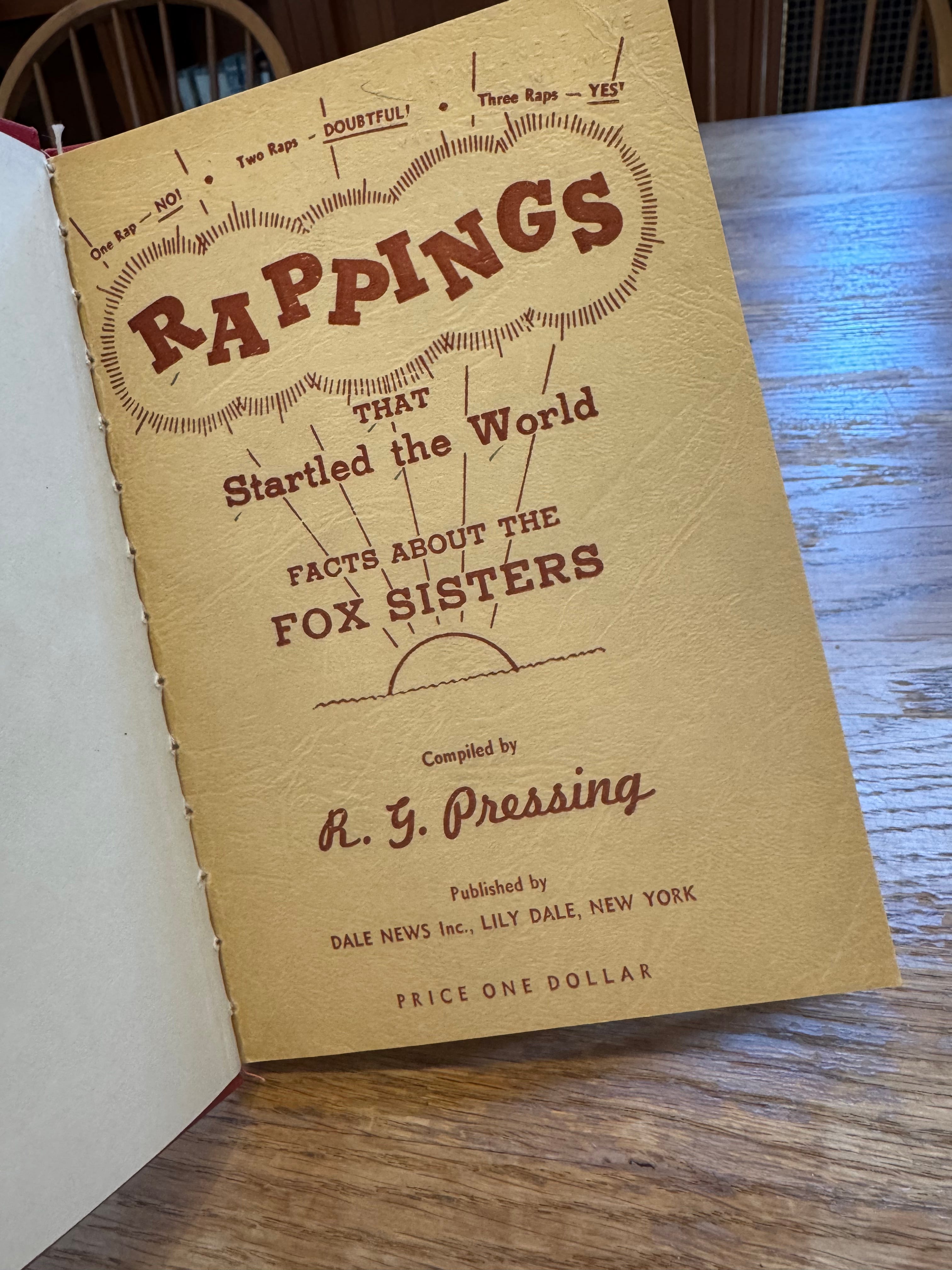
It’s full of interesting tit-bits, like the fact that in 1905 the Fox house in Hydesville was moved wholesale to Lily Dale, a village or small town with a long history of links to spiritualism that sounds totally quirky and entertaining. The Fox house burned down in 1955, but prior to that mediums would receive visitors there and answer questions by rapping. A lot of the source material in Rappings that Startled the World seems to come from the collection of Marion Buckner Pond who also wrote about these sisters in a book called Unwilling Martyrs ( also called Time is Kind) in 1947. This one’s not available online though, and isn’t cheap on Abebooks either, and so unless a writer was planning some kind of dual time line story (not unimaginable) then Buckner Pond’s book about the sisters might be surplus to requirements.
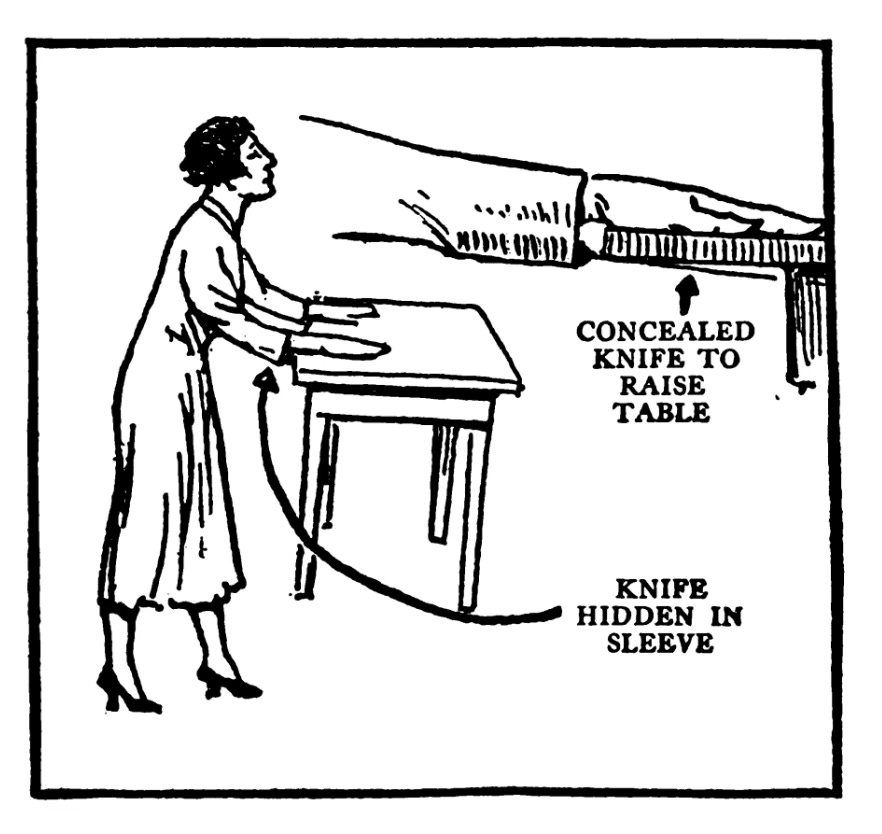
A better lead for the future Fox novelist, however, might be Emma Hardinge Britten’s 1870 book, Modern American Spiritualism. And a writer attracted to the idea of exposing how all the tricks of spiritualism were achieved could definitely have fun reading The Table Rappers by Ronald Pearsall, or Spook Crooks by Julien J. Proskauer where I found this illuminating illustration:
But before going too far, the writer might want to be sure there’s a story about the Fox sisters that would work for a novel. And that’s where my problems start.
The Fox sisters’ story really isn’t a happy one. The two younger womens felt manipulated and exploited. It reminds me of modern day child stars like Nickelodeon’s Jennette McCurdy whose memoir, I’m Glad My Mom’s Dead, I read a year or so ago). From a young age, Kate and Maggie were constantly working, they were regularly investigated, and sometimes publicly harassed. They were also often exploiting grieving families, and mothers in particular. Leah managed to marry well and retire from the business while maintaining status within the lively spiritualist community but life was harder for the Maggie and Kate. Maggie’s relationship with Elisha Kane feels a bit ick, if I’m honest. He was much older than her and possibly rather controlling. He certainly disapproved of the only way she had of making a living insisting she gave up her medium work and went back to school. It seems he loved her, but not enough to fall out with his family over her, and after his early death in 1857, his family refused to acknowledge Maggie as his wife or pay her the money she believed Kane had set aside for her in his will. Kate fell in love with a much older man, a believer in spiritualism, who she met while working in London. They had two sons, but after he died and she was left a widow, Kate needed her work as a medium to make ends meet and even took her boys with her to work in Russia for a time. By the 1880s, and back in America, both Maggie and Kate were highly dependent on alcohol to get through each day. On May 4th, 1888, Kate was arrested:
Under the wisecracking headline “The Spirits Too Much for Her,” the following day’s New York Herald reported that “one of the notorious Fox sisters” had been charged with “drunkeness and flagrant neglect of her maternal duties.” The paper suggested that neighbors had complained of her erratic behavior, but Kate suspected that Leah and other spiritualists, embarrassed by her conduct, were really the ones to blame for her detention and the fate of her two boys. Fergie, aged fourteen, and her younger son, Henry, thirteen, had been removed from their mother’s care and placed in the city’s Juvenile Asylum.5
There’s no lack of drama or conflict in the Fox sisters’ story. But is there a heroine? I’ve even written in my notes, as I worked in the Boston Public Library - do I even like these women?? That might seem a little simplistic, but it’s an important issue for a novelist and something that sets fiction and non-fiction apart.
The ah-ha moment is also yet to arrive. By which I mean the point in the research where the writer just knows there’s a novel there, a story asking to be told, however long it might take to make that happen. At the risk of sounding a little spiritual (pun intended) or me, the Fox sisters’ story hasn’t spoken to me in that way, at least not yet.
But if someone else felt like turning their story into a novel, I’d be first in the queue to buy it.
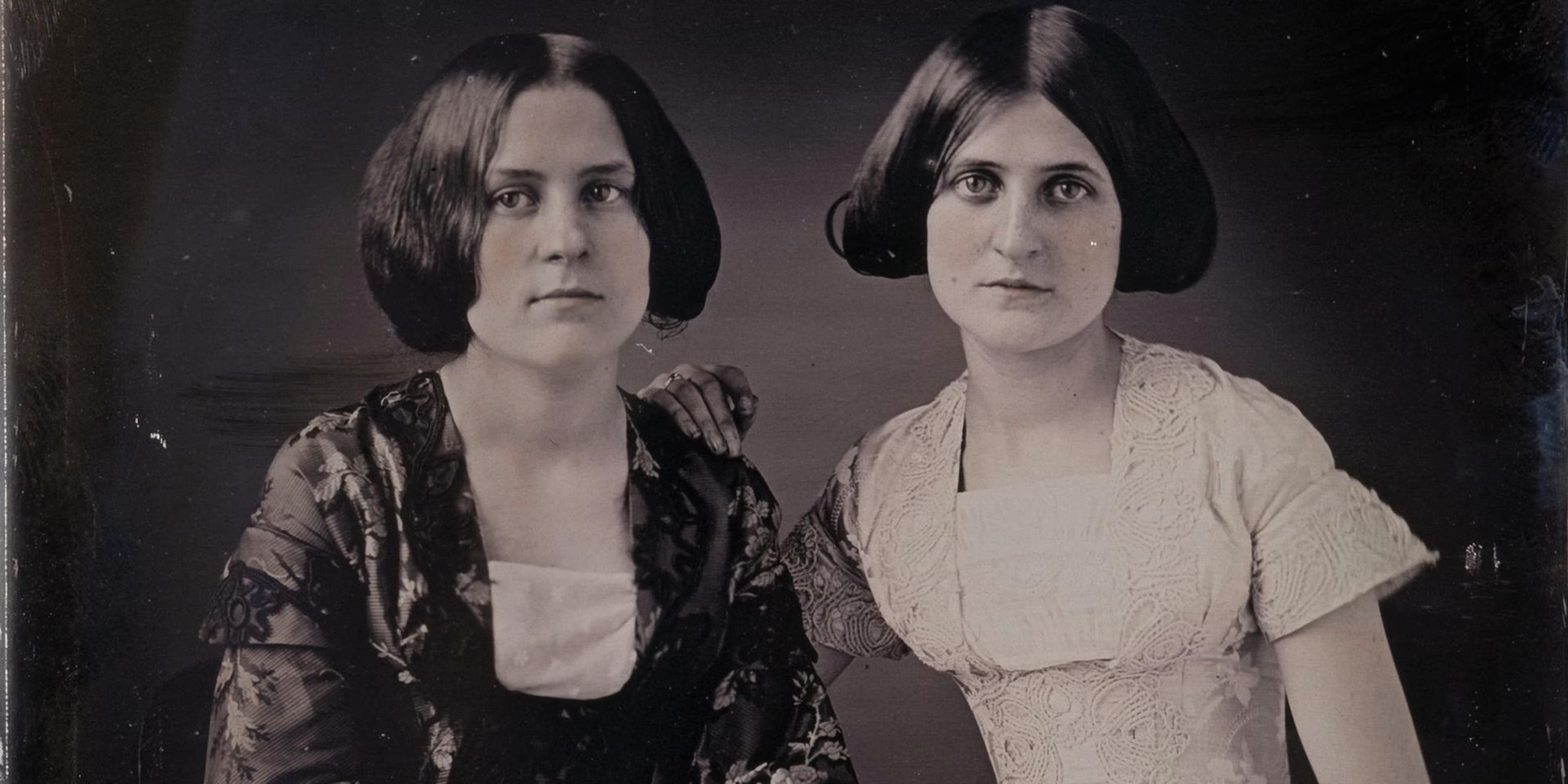
American Spirits, Barb Rosenstock, 2025
The Death-Blow of Spiritualism, Reuben Briggs Davenport, 1888.
Mrs Fish again. Leah Fox married several times.
The Death-Blow of Spiritualism, Reuben Briggs Davenport, 1888.
Out of the Shadows, Six Visionary Victorian Women in Search of a Public Voice, Emily Midorikawa, 2021
This is so interesting, Kate. I thought the Fox sisters sounded familiar and remembered that they inspired Victoria Claflin Woodhull and her sister Tennessee Claflin, who were traveling "spiritualists" before going on to do all the other crazy things they did (like Victoria Woodhull running for president in 1872).