

In at the deep end
Virginia and Vanessa: the Stephen sisters

Happy New Year everyone!
It has been a while since my last sister story, but… new year, new me and all that! I spent the last months of 2025 very busily writing my next novel and it seemed to take up all my writing capacity. With a full draft now in the bag (more or less), my thoughts are returning to sister stories.
Deciding where to begin anything is tough. I taught the first of a series of novel writing classes this past weekend and so ‘starting’ has been very much on my mind. How do you start a project? How do you set about writing a novel? What turns an idea into an actual piece of work? How do you know if your topic or theme has legs? You might think x is a fascinating subject right now, but will you still think so months down the line? I’m talking with these writers, posing them questions, and discussing the many things to be considered when embarking on writing a novel. And while the form may be different, it keeps occurring to me that I should ask myself many of the same things about where I’m going with my sister stories project.
Sometimes the decision-making involved in writing becomes overwhelming. So many choices. So much to say, but is it worth saying? So much material, but so much research required. Sometimes, it feels almost easier not to start. But as I said in the class, that just won’t do. The first rule of writing is… do some writing. So here I am starting the year with my first pass at finding out about a pair of sisters high on my to-do list: Virginia Woolf and Vanessa Bell.
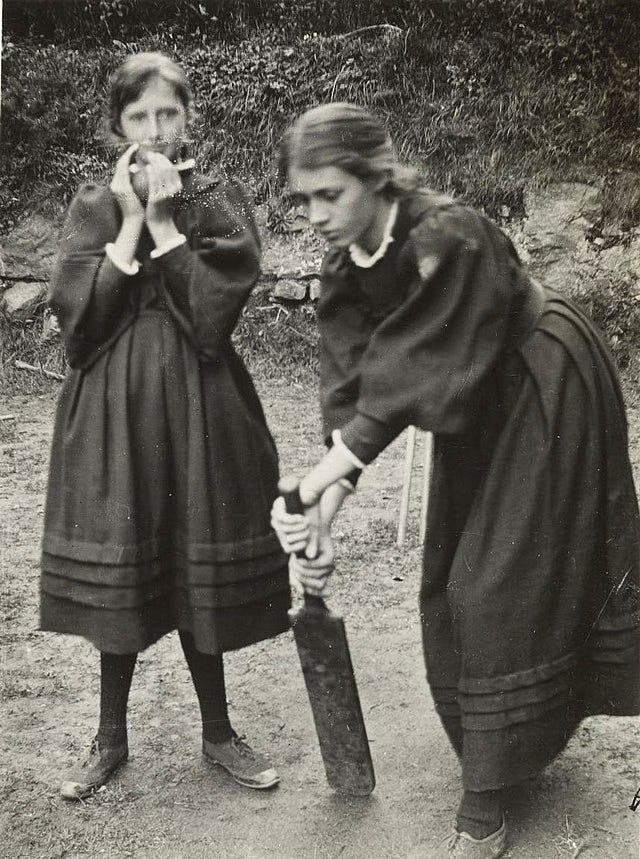
What do I know about them? Honestly, not a lot. I read Mrs. Dalloway at university. I didn’t enjoy it. I never got past page 3 of The Waves. I know Virginia Woolf killed herself. I know she wrote A Room of One’s Own, an essay I believe I’m fully in agreement with - without having actually read it! I know Vanessa Bell was a painter. I’ve heard of the Bloomsbury Group. And I suspect there are any number of biographies out there about the Stephen sisters: which is why I decided to begin with a novel. Historical fiction is a wonderful gateway to history, and thank heavens for it, because I’ve jumped right in at the deep end of sister stories with this pair.
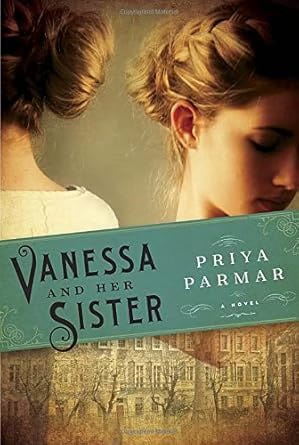
Vanessa and Her Sister opens with a letter from Virginia to Vanessa, written in 1912, when the sisters are thirty and thirty-three years old respectively. There has been a rift. Virginia writes:
“Am I still loveable? Or have I undone that now? No, Nessa, it must not be. What happened cannot break us. It is impossible. Someday you will love me and forgive me. Someday we will begin again.”1
It’s immediately intriguing, and made more so as the narrative jumps back seven years to 1905 and readers are brought into Vanessa Stephen’s imagined personal diary . Her sister is top of mind from the get-go:
Long ago Virginia decreed, in the way that Virginia decrees, that I was the painter and she was the writer. “You do not like words, Nessa,” she said. “They are not your creative nest.” Or maybe it was orb? Or oeuf? My sister always describes me in rounded domestic hatching words. And, invariably, I believe her. So, not a writer, I have run away from words like a child escaping a darkening wood, leaving my sharp burning sister in sole possession of the enchanted forest. But Virginia should not always be listened to.2
The story that follows paints a picture of complex sisterly tensions. Virginia has been their father’s favorite, her siblings have been told to tread carefully around her. Vanessa declares:
But then I remember what Mother and Father always told Thoby and me. When one has a sister as extraordinary as Virginia, one must put up with a fair amount of inconvenience. True, but it does not make her any less exasperating.3
Exasperating, but also mentally fragile, Virginia is Vanessa’s burden throughout their twenties. In the wake of the deaths of their parents and elder half-sister, Stella, Vanessa is the family caretaker, the person who orders the food, arranges travel, and pays the bills. If Virginia has a bad day, Vanessa’s day is lost in dealing with it. Which is not to say it’s all resentment. Vanessa paints Virginia over and over, saying:
I always paint Virginia. I tell myself that it is the lean planes of her beautiful face that draw me, but really, it is her company I seek.4
There is a sense though, that when Vanessa marries Clive Bell, she does so in order to escape Virginia. There’s an intensity in her younger sister’s love for her that Vanessa’s concerned by, although she’s slow to perceive the betrayal to come. I won’t spoil the book with too much detail here, but I do want to share this from the scene (entirely fictional according to the Author’s Note at the end of the book) where Vanessa confronts Virginia about her actions (which do seem to be historically accurate). It’s powerful stuff from Vanessa:
“You have pursued this, Virginia. And I could have forgiven you, had you fallen in love with him. Had you felt sincere passion or even real affection, I could have made sense of my sister doing this atrocious thing. But you are not in love. You are jealous. You cannot bear to be left out. And so you have broken what you could not have.”
“And what if it is broken?” Her chin lifted in rebellion. “He is not enough for you, Nessa. He is not up to being a man in our family. I am your sister. Our relationship is unbreakable. What does it matter what happens between you and that thing, Clive?”
“Nothing is unbreakable,” I said quietly.
Virginia stood still. All her wildness tamed.
Still later (three am)
I go over it in my mind how I should have said this, and this. How I should have raised all her terrible destruction to the surface like a shipwrecked boat dredged up from the sea floor. But that would have given the fracture a shape a dimension - a definite perimeter to the ruin. This way has a subtle cruelty. This way will torment. She will spend years trying to map the rift she caused and sound the damage. She will push on the bruise and go frantic trying to repair the creeping remoteness. It is the unkindest thing I have ever done. And I will not relent. I will not do otherwise. Damn her. And damn him.5
Vanessa and Her Sister ends with Vanessa’s reply to her sister’s pleading letter in 1912. That’s before Virginia has published her first novel, but after Vanessa’s paintings have begun to find recognition, including this one, which (in the novel at least) was part of Roger Fry’s second post-Impressionist exhibition in London in 1912.
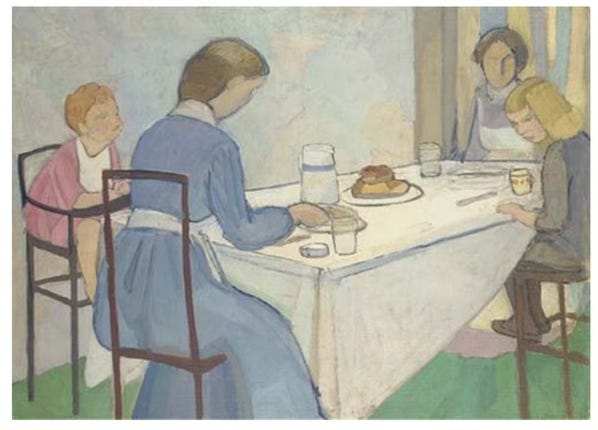
Clearly, I have more reading to do to find out how the Stephen sisters’ story continued, but I do know that Vanessa provided the artwork for all Virginia’s novels published by herself and Leonard Woolf.
For more on this intriguing pair, I’m turning to Jane Dunn’s 1990 book, A Very Close Conspiracy, Vanessa Bell and Virginia Woolf. As Parmar did, Dunn opens with the sisters’ division between writing and painting, although for Dunn the apportioning of spheres is a joint decision. And just in the introduction she hits on many of the things that fascinate me about sister relationships:
With sisters, there is the possibility of the most intimate and enduring of relationships. A sister survives parents; she is there long before lovers and husbands and children. She shares the same gender and generation, the same house, often the same room, sometimes even the same bed. Each travels through life alongside the other and shares as a as a contemporary the experiences of school, of independence, of love affairs, work, marriage, and motherhood. More often than not, she is there in old age, when lovers or husbands may have deserted or died; when children have left to make their own way.
For many there is the longing to be one and, at the same time, the struggle to be two. In this way the relationship of sisters has the potential for intense rivalry competitiveness, suppression, conspiracy, and fierce protective love. Yet it is given so little weight, is barely even discussed.6
So, A Very Close Conspiracy certainly needs to be read, and I’ve another sister fiction avenue to explore as well. Morgan in Vanessa and Her Sister, a member of the Bloomsbury Group, is better known to us now as E.M. Forster. He’s the first of the group to really make his mark, publishing Where Angels Fear to Tread, Room with a View (what a book, what a movie!) and one other during the seven years the novel covers. Of course this commentary from Vanessa jumped out at me:
I finished Morgan’s beautiful new novel on the train. It is about sisters: one wild and uncompromising but breathtaking in her courage. And one practical and reasonable, and unhappily bound by her good sense. Elinor Dashwood and Marianne. Margaret and Helen Schlegel. Even the name is haunting: Howards End.7
A classic featuring sisters? Howards End just leapt right to the top of my TBR pile.
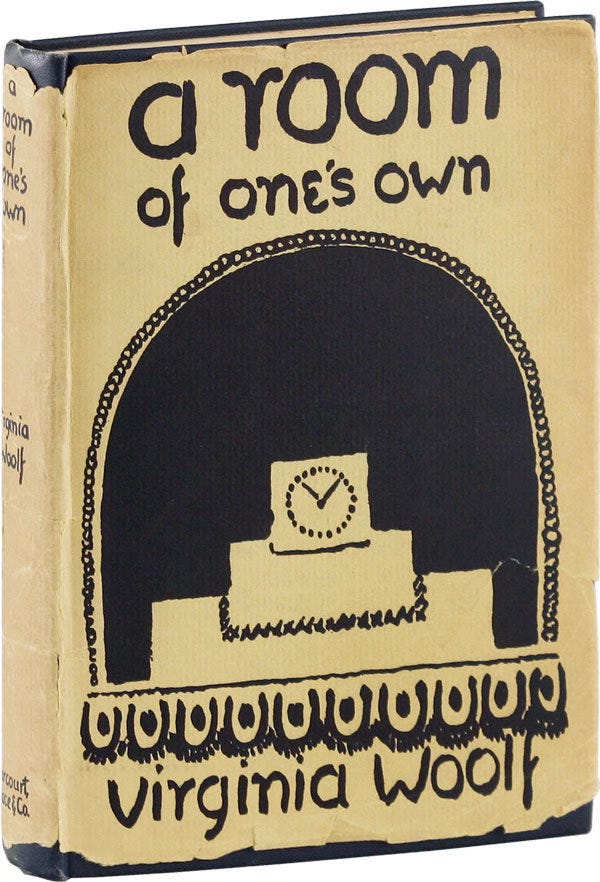
That’s all I have on the Stephen sisters for now, but it feels like a good start. There’s another novel about them - Vanessa and Virginia by Susan Sellers (I have an anxious feeling that this book looks familiar and I may have it already - where though? where?) and I’m considering watching the movie The Hours as another follow up activity. Oh, and I mustn’t forget about A Room of One’s Own - that definitely is now a must-read.
In the meantime, for a little more on Vanessa Bell’s art, I enjoyed this fairly recent Guardian article, and this is an interesting read about the book covers Vanessa designed. Finally, if the Bloomsbury Group has sparked your interest, don’t miss out on the Beyond Bloomsbury substack! I’m a fan.
Happy reading and thanks for subscribing.
Kate
Vanessa and Her Sister, Pray Parmar, Ballantine Books, 2014
ibid
ibid
ibid
ibid
A Very Close Conspiracy, Vanessa Bell and Virginia Woolf, Jane Dunn, Little Brown & Co, 1990
Vanessa and Her Sister, Pray Parmar, Ballantine Books, 2014
Hi Kate, and happy new year. Congratulations on finishing your draft. Does your have a publishing home? I didn't quite glean that from this piece. Whenever it sees the light of print, I would love to give it some coverage. And yes, do watch The Hours! Or preferably read it first; the book is wonderful. The film is a decent adaptation (other than Nicole Kidman's prosthetic nose, so unnecessary).